
We are always on the lookout for innovators who are genuinely shifting the paradigm in the startup ecosystem. This week, we sat down with Meeran Malik, CEO of Kuanta, an advanced agentic platform transforming how VCs, corporate innovation teams, and accelerators scout and evaluate early-stage companies.
In the interview, Meeran shares his journey from the corporate to the startup world, describes how Kuanta is fixing a broken evaluation system, and gives concrete examples of startup evaluations.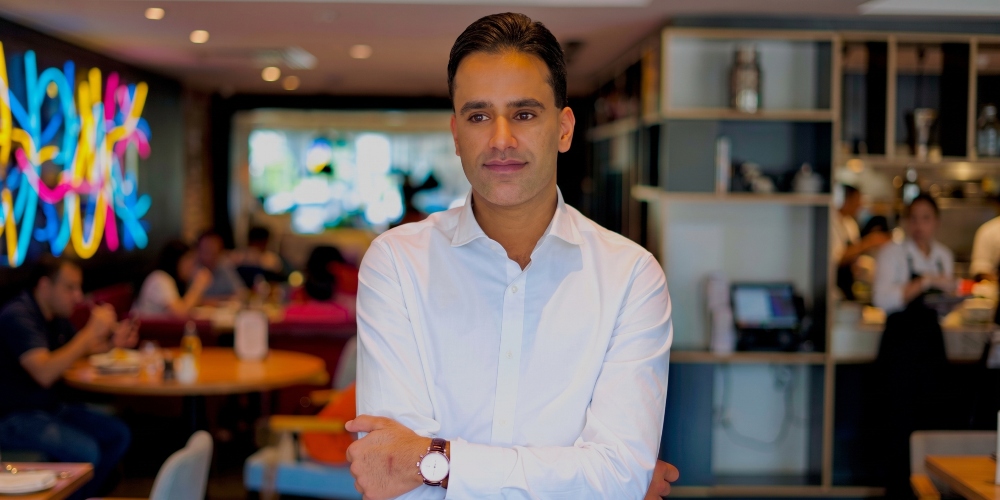
- Hi Meeran, thank you for agreeing to do the interview. Could you please let us know how you first got connected to the startup world?
I have always been interested in startups, even before I really knew what they were. I spent the earlier part of my career at a large consultancy, working across many different industries. The projects I kept ending up on were the ones with founders in the room.
Something about them felt different; less politics, more belief. These were people building something new from scratch, taking real risks, and trying to make an impact. The consultancy work taught me how to read a business, but the founders showed me what was actually worth backing. After that, there was no going back.
- You’re the CEO of Kuanta, an agentic platform for startup scouting and evaluation used by VCs, corporate innovation teams, accelerators, governments, and universities. Tell us more about your mission.
In short, we want to make sure you find the startups you are looking for, especially in places where you would not expect them.
In most databases, it’s difficult to find startups that are truly relevant for your case. Investors and corporates keep missing the startups that actually solve their problem and end up with a list of generic peers that do not really fit. This is because they use keyword search and rank all startups against the same criteria.
We know that a pre-seed biotech is different from a Series A SaaS. That’s why we built our startup database around industry-specific metrics. By scouting with our database, you will finally find the needle in the haystack. Once you’ve found the right startup, you can dive into their pitch deck and gain a deep analysis of their claims that are cross-checked with the latest news and credible sources, so your analysts don’t have to spend time doing this work manually anymore.
A world where every business idea is judged by the same standard, everywhere. That is the infrastructure we are building.
- Could you tell us about the due diligence startup analysis that you do with Kuanta? Could you give us examples of startups that are currently on Leapfunder?
Every Kuanta evaluation is built on three core pillars: validation, interpretation, and benchmarking.
Validation: We validate every single founder claim, number, and market figure against external sources before it ever enters our reports.
Interpretation: This is where the magic happens. We have built 19 industry-specific frameworks with over 645 scoring criteria to ensure that a pre-seed biotech and a Series A SaaS are judged by their own unique metrics.
Benchmarking: Finally, we compare the startup to its real peers using our database of 3.7 million validated profiles, ensuring its Kuanta score reflects what is actually out there in the market today.
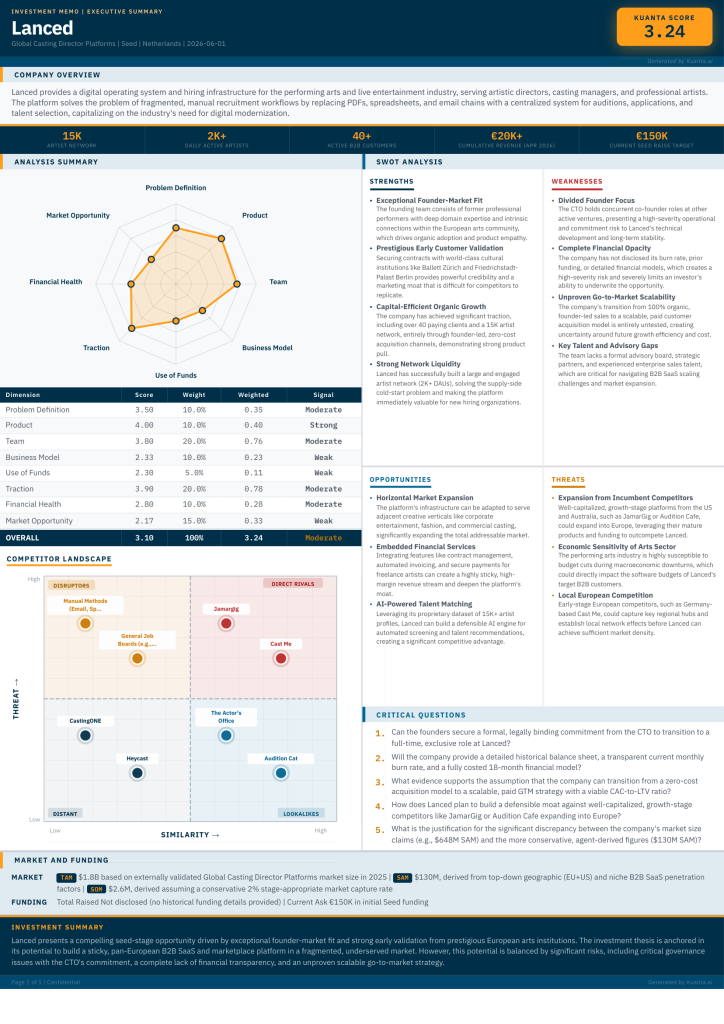
Our reports outline the strengths, weaknesses, and specific questions an investor should ask the founders before writing a check. Here are examples of two Leapfunder startups:

- Please share three pieces of advice for founders that are vital for a startup’s survival.
Hire slow and fire fast: The single biggest factor in whether an early-stage startup makes it is the quality of the first ten people. Most founders underestimate this because hiring feels like progress. But at a fragile, early stage, it can be the wrong kind of progress if the person is the wrong fit for the role.
Radical focus: This sounds easy, but it may be the hardest thing to do. Most startups die from doing too many things at an average level instead of doing one thing exceptionally well. The discipline lies in saying “no” to 90% of what looks attractive and fiercely protecting the 10% that actually moves the needle.
Narrow your customer base: Pick one type of customer who feels the problem the most, build exclusively for them first, and ignore the rest. Trying to serve everyone in the early days means you’ll end up with a bland product that serves no one.
- Could you tell us about the startup ecosystem in Singapore? What are the opportunities and challenges it’s facing?
In 2026, Singapore is the most concentrated startup market in Asia, which is simultaneously its biggest strength and its biggest risk.
On the plus side, the city-state attracted roughly 91% of all Southeast Asian venture capital in 2025, climbed to fourth on the StartupBlink global ecosystem ranking, and recently added Supabase to its unicorn list at a $2 billion valuation. Furthermore, Budget 2026 added another billion Singapore dollars to Startup SG Equity, and MAS’s Project Guardian framework for tokenized assets is now live with over forty institutions. The regulatory clarity here is something most European hubs would envy.
But the flip side is very real. That massive 91% funding share actually comes from a regional market that closed only 461 equity deals last year — the lowest count in over six years. Many prominent local investors have publicly noted that pre-seed founders are currently starving for cash while late-stage rounds flow freely. Combined with high talent costs, where median tech salaries now sit at S$8,450 a month, and an SGX exchange that produced only a handful of tech-relevant listings, the local market has its hurdles.
My advice for the European angel investor? Use Singapore as your base, not as your market. Utilize it for the robust legal setup, the IP protection, the regulated payment rails, and the world-class AI infrastructure. But build your actual customer base across growing markets like Indonesia, Vietnam, India, and Japan. The founders who understand that distinction are the ones who will ultimately win.
Thank you for sharing your insights with us, Meeran. We wish you the best of luck in your future endeavours.
Join our network of startups & investors!

 Log in with Linkedin