
Eva-Maria Markutzik is the Lead and Community Manager at the MAFINEX Technology Center in Mannheim, home to around 80 startups spanning IT, AI, and sustainable technologies. With a background in entrepreneurship education and ecosystem building, she plays a key role in shaping the regional startup landscape.
We spoke with Eva-Maria about her journey into entrepreneurship, her work at MAFINEX, and why angel education is critical for sustainable innovation ecosystems.
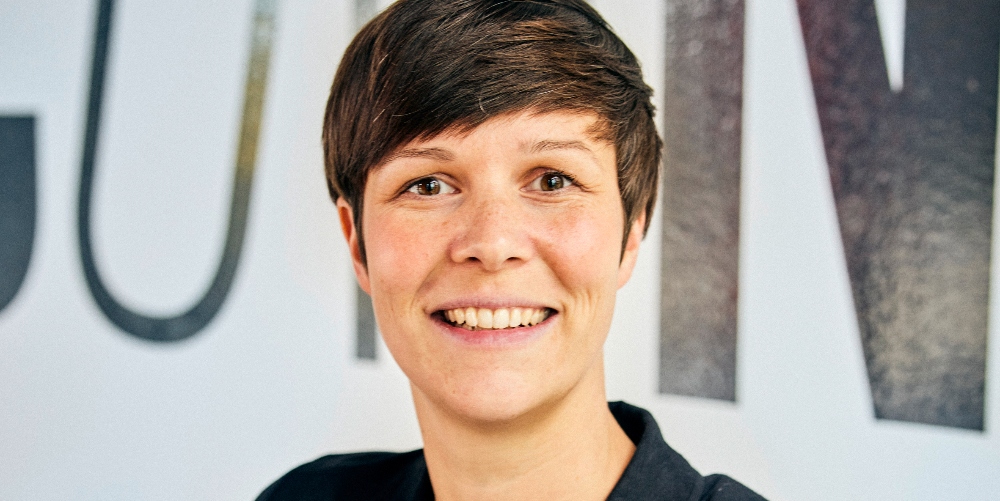
- Eva-Maria, thank you for joining us. Could you start by telling us about your background and how you first became involved in the startup world?
My path into entrepreneurship wasn’t planned in a classical sense. I became self-employed during my studies, initially more as a practical solution than a deliberate career choice. What surprised me was how formative that experience turned out to be. I suddenly had the freedom to shape projects myself, take responsibility, and learn extremely fast.
That experience raised an important question for me: why does entrepreneurship play such a small role in academic education, despite being such a powerful learning environment? This personal “creative quest” led me into entrepreneurship education, startup support, and eventually ecosystem-building roles. Over time, my focus shifted from working on individual projects to designing environments that support the growth of many people, which ultimately led me to my current role at the MAFINEX Technology Center.
- What’s your mission as the Lead and Community Management at MAFINEX Technology Center, currently the home for around 80 startups covering the full range of tech and IT, from AI to CircularEconomy?
My mission at MAFINEX is to create an environment where founders can fully focus on building meaningful and sustainable companies. Providing office space is just the starting point.
We actively connect startups with business angels, corporates, universities, and public partners, while also fostering strong peer-to-peer learning within the community. Founders often learn most effectively from each other. The overarching goal is long-term company building—not short-term hype, but resilient businesses that can grow and last.
- You’re a professional building innovation ecosystems. Could you please share what it is about innovation that particularly attracts you? What’s the most important advice you would share with IT and Tech startup founders?
What fascinates me most about innovation is its deeply human side. Innovation happens when people with different backgrounds share perspectives, challenge assumptions, and are willing to learn openly. Technology is an important enabler—but trust, curiosity, and collaboration are the real drivers.
For IT and tech founders, my most important advice is to stay close to real problems and real users. Don’t fall in love with your solution too early. Build feedback loops as early as possible, stay humble, and invest in relationships—with customers, partners, and investors alike.
-
Leapfunder recently held an Angel Clinic in Mannheim. Why would you recommend angels to participate in this training?
Inspired by our long-standing “Angel in Residence”, Christoph Räthke, we had a clear objective: to attract more private investors who actively support the growing startup scene in our region. Many people are willing to contribute to innovation with both expertise and capital — the real barrier is often uncertainty about how to get started.
The Angel Clinic addressed exactly this challenge. It provided a proven toolkit, a clear structure, and excellent guidance from Tienko Rasker. The impact was very tangible: out of 25 participants, around 10 immediately connected with our regional network and continued with concrete startup matchmaking conversations. This showed us how powerful hands-on, locally embedded angel education can be.
As a professional focused on building strong innovation ecosystems, I highly recommend the Angel Clinic training. Its hands-on format and real-world focus make it an outstanding learning experience. Whether you are just starting out or already an experienced expert, the training delivers practical value at every level.
- Tell us about the ecosystem in Mannheim. What are the opportunities and the challenges it’s facing? What do you predict for the near future?
Mannheim has a strong foundation for innovation: excellent universities, applied research, a diverse startup base, and growing collaboration between public institutions, corporates, and investors. A major opportunity lies in B2B-driven innovation and sustainable technologies, where the region can build on its industrial heritage while developing forward-looking solutions.
At the same time, funding — especially follow-on and early growth capital — remains a challenge. That’s why initiatives like new angel networks, including one driven by alumni of Mannheim Business School focusing on academic spin-offs, are so important.
Looking ahead, I see great potential in aligning sustainable and impact-driven business models with investors who value long-term societal and environmental impact alongside financial returns. If we continue to professionalize angel engagement and strengthen collaboration across the ecosystem, Mannheim is very well positioned for sustainable growth in the coming years.
Thank you for sharing your insights and story with us, Eva-Maria. We wish you the best of luck in your future endeavors.
Join our network of startups & investors!

 Log in with Linkedin