
From guerrilla marketing in Madrid to unifying Europe’s innovation ecosystems, Olivia Czetwertynski has spent nearly two decades at the intersection of communication, entrepreneurship, and community-building. As co-founder of Unboxing the Future and a consultant at the Berlin Innovation Agency, she believes that clarity, collaboration, and culture, not just technology, are what truly drive innovation forward.
We talked about her journey into the startup world, her mission to make complex topics accessible, and why Berlin’s future lies in mission-driven, collaborative companies.
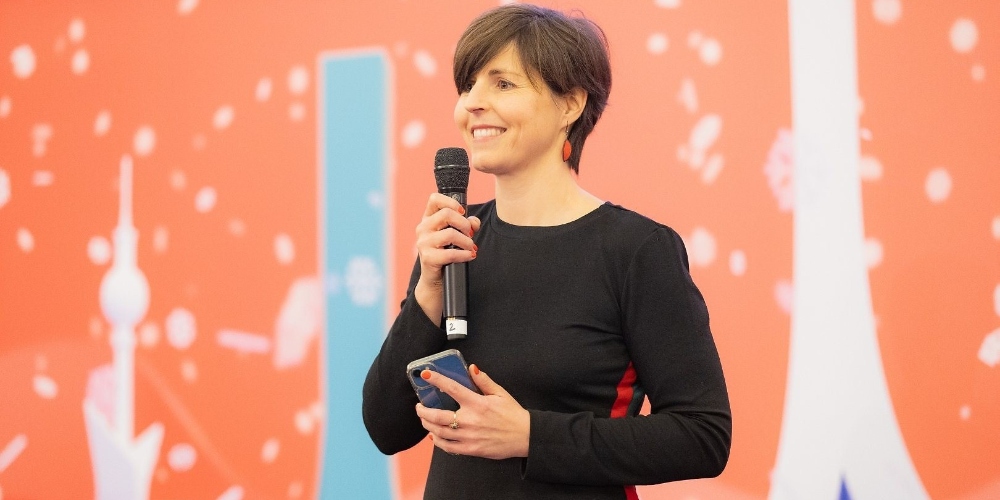
- Olivia, can you tell us about your background and how you first connected to the startup world?
I’ve been orbiting around startups long before we even called it an “ecosystem”. I started my career in big advertising agencies (MRM Worldwide, Saatchi&Saatchi, TBWA), learning how brands’ narratives are built and how stories move people. That was my school: tight deadlines, big clients, and the constant pressure to make communication work in the real world.
My entry into the startup world happened in Spain (Madrid) around 2009, when social media was still the wild west. I co-founded influenzia.net, one of the first blogger platforms in Spain, and suddenly found myself in this messy, exciting world of early digital entrepreneurs. There was no playbook, no “ecosystem”, no cool startup vocabulary. Just bloggers experimenting, writing about brands and experiences in their own voice, on their own blogs.
At the time, Facebook, Twitter, and Instagram were just emerging. We were organizing large-scale events with bloggers, long before anyone used the word “influencer”. We would walk into meetings with big brands and say: “Look, these bloggers will write about your brand, honestly, without prior approval.” For traditional marketing teams, that was a shock. You could feel the old world and the new world colliding in real time.
After the agency was acquired by a large advertising group, another turning point came when a friend told me, “We are going to change the world,” and showed me a 2,000-square-meter space near Plaza Mayor in Madrid. We started what we called a “free workers” space, without even knowing the term coworking yet. It became one of the first coworking spaces in Europe, called utopic_US. Very quickly, we expanded to several buildings and around 6,000 square meters, which was enormous in 2011-12. Without really planning it, we found ourselves in the middle of the early European coworking movement, experimenting with a new way of thinking about real estate, work, and community. In 2017, the company was acquired by a large Spanish real estate group.
In parallel, I became press officer for TEDxMadrid, built strong relationships with American journalists, and started supporting startups to gain international media exposure, especially in North America. From there, I developed my own strategic and data-driven communication practice, based on two methodologies I created – the Go-Press-Guide and the Communication Diagnostic – designed to equip startups and scale-ups to use communication as a real growth engine for international expansion.
When I moved to Berlin in 2015, I continued mentoring startups on B2B/B2C strategic growth through communication, working with major accelerators and incubators in Europe. I also worked with betahaus, a pioneering European coworking space in Berlin, and its innovation agency betahausX. Today, my work sits at the intersection of innovation strategy, data-driven communication, and ecosystem building, mostly from Europe, always with an international lens.
- You co-founded Unboxing the Future, a talk show that makes complex topics accessible. What’s the mission behind it?
Unboxing the Future was born from our belief: serious doesn’t have to be boring. We take complex topics and turn them into accessible and memorable knowledge, using the power of entertainment as our main tool. Entertainment is the way we open people up, lower the pressure, and make space for real insights.
Diego, aka Ain TheMachine, my co-founder, creative director, and the show co-host, is a Latin Grammy-nominated musician with more than 15 years of experience creating tailor-made content for leading global brands using music and storytelling.
At Unboxing the Future, Diego designs a set of surprising and entertaining dynamics that completely change the atmosphere, which leads to unfiltered, open, honest, and raw conversations. This includes doing live electronic music with our guests: one of our signature moments is when guests bring an object to introduce themselves. Diego turns that object into an instrument and builds a live electronic track on the spot. That’s very different from a traditional studio interview.
Every conversation is very intentional. The way we frame it is rooted in research, curation, and our clear “Communication Diagnostic” methodology. We use it to make decisions on the topics, the speakers, and which questions will truly resonate, open new angles, and connect with the audience’s real concerns.
The magic of Unboxing The Future lies in the union of Ain TheMachine’s live entertainment and analytical storytelling, my strategic and data-driven communication approach to curate every session, and Iva Jankovic’s (show co-host) live event curation expertise.
Unboxing the Future is both a talk show and a live event series. We record episodes in studios, and we host live events around them with additional special guests. We also curate and moderate stages at large-scale conferences, for example, at GITEX Europe or AsiaBerlin Summit, where we had 10 or even 15 people on stage, presenting an ecosystem as a living, collaborative organism, ditching lists of logos and slide decks.
At its core, Unboxing The Future is about ecosystem building and unification. It’s a place where decision-makers, corporate leaders, founders, and curious citizens meet in the same room. You can ask bold questions, speak directly to decision makers, and actually take part in the conversation.
We started with Berlin and quickly realized that Berlin is like a “mini-Europe”: very open, but highly fragmented. Our vision now is to “Unbox Europe”, to show the red thread that connects different ecosystems and help people see how they fit into a bigger picture. On this journey, we have worked and collaborated with key ecosystems in Berlin: betahaus, Fraunhofer HHI, Silicon Allee, Make.org, Enpact, CIC/Venture Café, Berlin Music Commission, and, most recently, the Berlin Senate/Berlin Partner. In 2026, the format is travelling abroad: See you at SXSW, we will rock the German Haus with Berlin Partner in Austin in March!
- You’re also a consultant at the Berlin Innovation Agency. What attracts you most about innovation work there?
What I really appreciate about the Berlin Innovation Agency (BIA) is its belief that innovation is only successful if it changes behavior. Technology alone isn’t innovation; it’s just a tool. Real innovation happens when human attitudes and routines shift. Today, BIA has positioned itself as an expert agency in AI and leadership training through its spinoff HelloCircle, built on the conviction that better companies make a better world.
With BIA, I have been managing a large-scale European project called U!Innovate, involving multiple universities across Europe and Ukraine. The goal is to build a framework that helps researchers, staff members, and students move from idea to market on an international level.
U!Innovate was born from a clear concern: Europe’s competitiveness is at stake in the race for its sovereignty, and universities can help win this race. European universities produce world-class innovation, but too often it stays local, stalls at the prototype stage, or never reaches the market because the right resources, partners, and know-how are scattered behind complicated processes.
U!Innovate is designed to change that. We’re creating a shared European pathway that helps universities and their students, researchers, and staff become truly entrepreneurial and scale climate-neutral and smart-city solutions beyond their local campus walls.
My piece of this puzzle is leading the design and implementation of the cross-European Mentoring Framework, a common support structure for entrepreneurship, and the global system around it. I see universities as “treasure chests full of unpolished diamonds” of ideas and talented people. We are designing a European joint framework to activate that potential and position it to compete internationally.
- As a mentor in accelerator programs, what are the three most valuable lessons you share with founders?
Clarity beats complexity. When you are in the field of deep tech or research-driven solutions, communication can be seen as a “decoration”, but it’s part of your business model. Often, your “buyer person” is not a technical person. Facts tell, stories sell. If people don’t get it, they can’t buy it, support it, or invest in it.
Don’t try to be a hero; build a support system. Founders often fall into the trap of doing everything themselves, which leads to burnout. Your network is not just for fundraising or business development; it’s also an emotional infrastructure. This is something we see strongly in female founder communities today, where mutual support is becoming more visible and powerful. Build your circle early: mentors, peers, other founders, even a WhatsApp group where you can be honest about how things are really going.
Pace yourself, startups are a marathon made of sprints. There’s always a temptation to sprint endlessly. But companies don’t die only from a lack of capital; they also die from founders who run themselves into the ground. So, protect your energy like you protect your runway. Be obsessed with learning, not just with growth. Make space to zoom out regularly and ask: Is this still the right direction? Resilience grows when you design it intentionally, in yourself and in your company.
- Let’s talk about the startup ecosystem in Berlin. What are the main challenges and opportunities you see, and what might the near future look like?
Berlin is still one of Europe’s most vibrant startup hubs. It remains Germany’s startup capital in terms of deal volume and number of startups, and is consistently ranked among the top European ecosystems, with thousands of startups and several billions in funding flowing through the city.
The city is incredibly open. Compared to cities like Paris or London, it’s much easier to access people and opportunities; there are fewer invisible layers of hierarchy. But that openness comes with fragmentation. There’s so much happening that founders can easily get lost trying to navigate it all.
One major focus in Berlin right now is deep tech and impact. The city is positioning itself as a capital for both, and what’s interesting is how those two areas intersect. Berlin is also home to many mission-driven founders, more so than in many other ecosystems. Collaboration is one of Berlin’s most unique traits. It’s something people here often take for granted, but it’s rare and incredibly valuable. Combined with international talent, diversity, and the ability to operate fully in English, this makes Berlin very special.
I see Berlin as the entry door to Europe for international founders, a place where you can land, plug into a community, and then expand into the rest of the continent. Looking ahead, I see a shift toward more mission-driven, collaborative, and “zebra-style” companies, businesses that prioritize sustainability and cooperation over pure hypergrowth. The narrative of “grow at all costs” is fading, and more founders are thinking in terms of resilience, profitability, and long-term impact.
That said, challenges remain. Funding has become tougher, especially at the early stages, which still pushes many startups toward the U.S. Bureaucracy, and administrative complexity can slow founders down. And inclusion is still a big topic: access to capital and networks is not evenly distributed, especially for female, migrant, and underrepresented founders. Still, I’m optimistic. Berlin’s DNA: its culture, openness, freedom to experiment, and low barriers to entry – gives it a unique edge for building the next generation of European innovation. If I had to summarise, I would say: Berlin’s next chapter will be less about unicorn headlines and more about resilient zebra companies that are built to last and built to matter.
Thank you for sharing your journey and insights with us. We wish you the best of luck in your future endeavors!
Join our network of startups & investors!

 Log in with Linkedin